
3/10/2026 Torchbearer Weekly Policy Update
Thank you for letting us be your trusted source for local, state, and federal policy updates.
Let’s dig in…
- Former Indianapolis Mayor Greg Ballard Declares for Secretary of State Race
- Indiana Board Finalizes New A-F School Accountability System
- Indiana Court Blocks Abortion Law in ACLU Religious Freedom Case
- Gov. Mike Braun Signs 80 Bills Into Law. Here Are Some Highlights.
- The U.S. Labor Market Lost 92,000 Jobs in February in Warning Sign for Economy
- Indiana’s Role in National Push to Protect Power Bills
- Braun Doubles Down on Addressing 'Imbalanced Relationship’ Between Utilities, Ratepayers
- Share the Torchbearer Newsletter with Your Network!
- Important Dates
Former Indianapolis Mayor Greg Ballard Declares for Secretary of State Race

Former Indianapolis Mayor Greg Ballard is entering the Indiana secretary of state race as an independent.
Why it matters: Ballard’s independent candidacy could shake up a race dominated by partisan politics, offering voters an alternative to the traditional party lines.
- Ballard emphasizes professional, nonpartisan governance amidst a “toxic” political climate.
Driving the news: Ballard, a former Republican, aims to minimize politics in the Secretary of State’s Office, challenging incumbent Republican Diego Morales and Democrat Beau Bayh.
- He believes an independent can better serve the office, citing his past success as Indianapolis mayor.
What’s next: If elected, Ballard plans to enhance voter engagement by distributing voter guides and reviewing Indiana’s voting practices.
- He criticizes straight-ticket voting and advocates for supporting local clerks in managing elections effectively. (IBJ)
Indiana Board Finalizes New A-F School Accountability System

Indiana has officially approved a new school accountability system, pending a few final signatures.
Why it matters: The redesigned A-F grading system offers a more comprehensive assessment of student progress, literacy, and post-graduation readiness.
- This model emphasizes individual student growth and incorporates a variety of success indicators.
- Schools will earn credit based on academic proficiency, growth, and success indicators, which differ by grade level.
The big picture: Indiana’s new framework aims to provide a roadmap for schools and families to achieve success.
- It shifts away from an “all-or-nothing” approach, focusing on reading and math mastery in early grades.
What’s next: The rule awaits approval from the state Attorney General and Governor.
- A transition year, “Year Zero,” will allow schools to adapt to the new system before grades count towards accountability. (Indiana Capital Chronicle)
Indiana Court Blocks Abortion Law in ACLU Religious Freedom Case

An Indiana court has blocked the state’s near-total abortion ban, following a legal challenge by the ACLU of Indiana.
Why it matters: The court’s decision protects individuals whose religious beliefs could be burdened by the law, highlighting the intersection of religious freedom and reproductive rights.
- The injunction is a response to the case’s classification as a class action, meaning the ruling applies statewide.
- The court found the ban imposed a “substantial burden” on religious practices protected by the Religious Freedom Restoration Act.
The latest: The ACLU announced the ruling on March 5, 2026, marking a significant moment in the ongoing legal battle over Senate Enrolled Act 1.
- Stevie Pactor, ACLU of Indiana’s Senior Staff Attorney, emphasized the ruling’s importance for religious freedom across various faiths.
What’s next: As the case progresses through the courts, the permanent injunction remains in place, preventing the enforcement of the ban. (Indy Star)
Gov. Mike Braun Signs 80 Bills Into Law. Here Are Some Highlights.

At the end of the week, Gov. Mike Braun has signed 80 bills into law, impacting a wide range of issues from Medicaid to homeless encampments.
Why it matters: These legislative actions underscore significant policy shifts in Indiana, aimed at addressing healthcare, public safety, and local governance.
- Of the 144 bills on his desk from the 2026 legislative session, two remain untouched, including one renewing Indiana’s syringe exchange law with new restrictions and another banning virtual currency kiosks.
Driving the news: Braun recently signed a bill allowing a new casino license in Fort Wayne, reinstating a local referendum requirement that was nearly removed.
- The governor’s cooperation with legislators helped avoid potential vetoes.
The bottom line: Gov. Braun’s legislative decisions reflect a balance between state needs and local approvals, with some bills becoming law without his signature. (Indy Star)
The U.S. Labor Market Lost 92,000 Jobs in February in Warning Sign for Economy

The U.S. labor market experienced a significant downturn, losing 92,000 jobs in February, highlighting economic vulnerabilities.
Why it matters: The job losses, driven by health care industry strikes and broader economic challenges, underscore potential weaknesses in sectors previously bolstered by health care demand.
- The unemployment rate rose to 4.4%, with forecasts initially predicting job growth rather than decline.
What they’re saying: “This is definitely a sign that the labor market is not reaccelerating,” says Andrew Flowers, Appcast’s chief economist.
- Despite this, the Trump administration downplayed the losses, citing extraneous factors like weather and strikes.
The bottom line: While layoffs remain low and consumer spending holds strong, February’s job report signals that more robust hiring might be delayed, posing risks to economic stability. (Washington Post)
Indiana’s Role in National Push to Protect Power Bills

Indiana is stepping up in a national initiative to curb rising electricity costs as AI technology grows.
Why it matters: As AI expands, electricity demands are soaring. Indiana’s proactive steps in energy management can set a precedent for balancing technological growth with cost efficiency.
- The state leads with a rate reduction filing, indicating its commitment to affordable energy.
The big picture: At a White House roundtable, tech giants like Google, Microsoft, and Meta signed the “Ratepayer Protection Pledge.”
- This agreement ensures these companies will support new power generation and infrastructure upgrades without burdening consumers.
What’s next: Indiana’s approach may ease local concerns about energy consumption spikes.
- The state’s central location, grid access, and available land make it a prime destination for AI data centers, promising jobs and economic opportunities.
The bottom line: Indiana’s leadership in energy initiatives highlights the importance of sustainable growth in technology sectors. (WIBC)
Braun Doubles Down on Addressing 'Imbalanced Relationship’ Between Utilities, Ratepayers
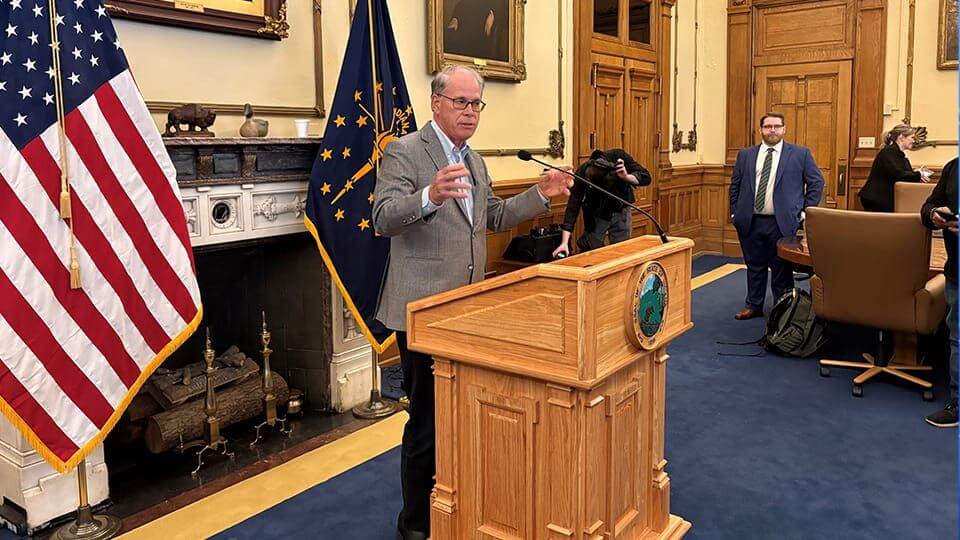
Gov. Mike Braun continues his campaign against high utility rates, emphasizing efforts to make energy more affordable in Indiana.
Why it matters: Indiana’s energy sector faces turbulence with rising utility rates and community divisions over data center projects.
- Data from the Citizens Action Coalition shows a 17.5% increase in electric bills between July 2024 and July 2025.
Driving the news: Braun attributes rising costs to inflation under President Biden and criticizes the lack of consumer support.
- He highlights legislative measures and new appointments aimed at controlling utility rates, like the appointment of a new IURC commissioner.
- Braun advocates for data centers to fully cover their impact on the electric grid.
The bottom line: While Republicans push for performance-based ratemaking, Democrats argue regulatory hands are tied, favoring utility companies.
- The debate continues amid concerns over rising gas prices and potential suspension of the state gas tax in response to geopolitical tensions. (Inside Indiana Business)
Share the Torchbearer Newsletter with Your Network!

Not signed up for our weekly newsletter? Sign up today!
Important Dates:

Important Dates:
May 5, 2026: Primary Election Day
May 12, 2026: Anticipated Technical Corrections Day